
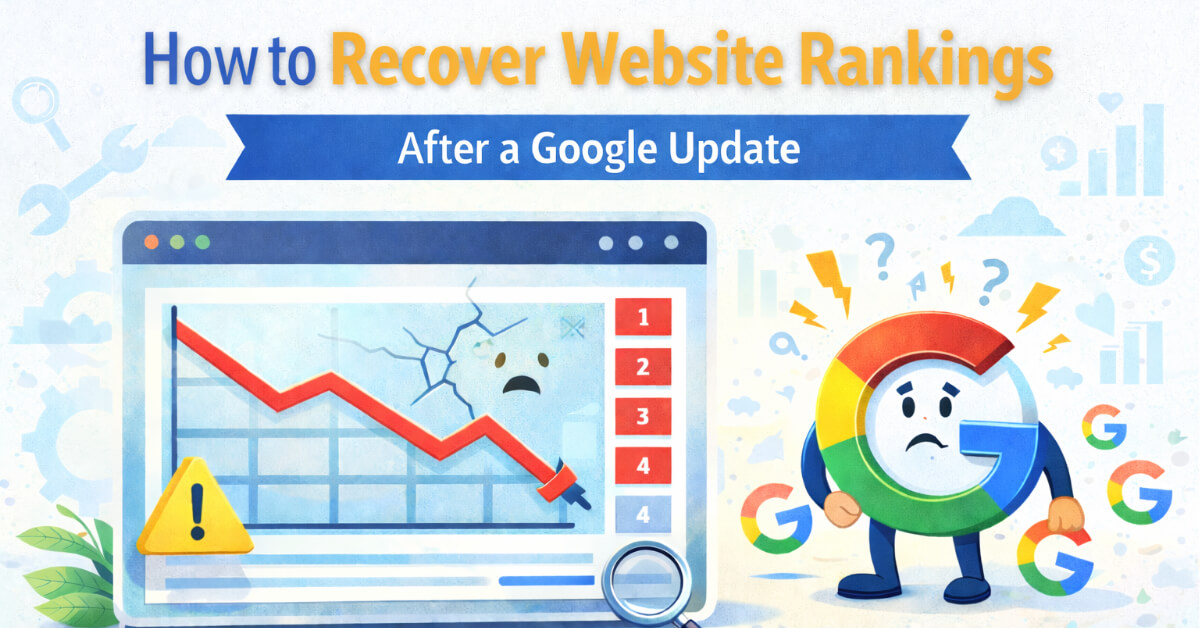
In case you are attempting to regain the rankings of websites following the Google update, learn this first, Google did not just drop your rankings without a reason. One of your web pages is no longer up to its new criteria.
The majority of businesses are emotional. They adjust several keywords, post random blogs, and wait until rankings come back. That approach fails.
We recover at Digital Catalyst differently, diagnose, fix, strengthen, and scale. When you do it right, recovery is not by chance, it is foreseeable.
Step 1: Find out what in fact caused the drop.
Find out the reason of your dropped rankings before implementing changes.
When your ranking in the search engine has dropped, and Google has updated it, it always indicates one of the following problems with your site:
- The quality of the content is poor in comparison to competitors.
- Search intent mismatch
- Poor user experience
- Weak authority or trust indicators.
What you have to examine:
- Google Search console > traffic drop timeline.
- What pages experienced a loss of traffic (not the whole site assumptions)
- Which keywords dropped
Don’t guess. Data first. Fix later.
Step 2: Know the Kind of Google Update.
Not all updates are the same. It is a mistake to treat them in the same way.
To recover successfully with the Google core update, you must be aware of the changes.
Common update types:
- Core Updates → Pay attention to quality and relevance of content.
- Content Helpful Updates → Put people first.
- Spam Updates → Block spammy or deceptive strategies.
The fixes needed to perform each update are different. When you use the wrong strategy, then you lose time.
Step 3: Repair the Quality of the Content (The Largest Factor)
Google does not reward content, it rewards useful content.
The content of most websites loses rankings due to:
- Generic
- Surface-level
- Written solely on keywords.
To be able to recover after a google update, your content should:
- Fully answer the topic
- Give genuine value (not duplication)
- Written first of humans.
Upgrade your content:
- Expand weak sections
- Include real examples or knowledge.
- Enhance the clarity (short paragraphs, clarity)
- Remove fluff
At Digital Catalyst, we do not produce more content, but produce better content.
Step 4: Resolve Mismatch Search Intent.
You may have content to the max–and not rank.
Why? Since it does not confirm to what users desire.
Example:
- Search terms used by users: recover rankings after update.
- Your page: general tips.
- Competitor: step-by-step instructions.
Who wins? Not you.
This is essential in seo recovery following the update in Google.
Action:
- Search for your target keyword
- Analyze top-ranking pages
- Outmatch or surpass their depth and structure.
Ranking has nothing to do with writing, it has to do with relevance.
Step 5: Enhance EEAT (Trust Signals).
Google evaluates:
- Experience
- Expertise
- Authority
- Trust
In case your site is not credible, your ranking decreases.
To achieve good recovery on core update on Google, correct this:
Add:
- Author names with credentials
- Life examples or real cases.
- Testimonials
- Clear About page
Google will not rank you unless it believes you.
Step 6: Revise Existing Content
It is not difficult to create new blogs. Where the real results lie is in updating old ones.
Your quickest seo recovery following a Google update comes out of:
- Enhancing already ranking pages.
- Expanding outdated content
- Including frequently asked questions and new information.
Focus on:
- Unproductive pages.
- Pages on page 2-3.
- Low click high-impression pages.
Don’t ignore what already exists. Fix it.
Step 7: Enhance Internal Linking.
The majority of sites are underperforming in this area, and it loses rankings.
Internal linking helps Google:
- Know your organization of content.
- Identify important pages
- Distribute authority
The reason why your site has dropped in the ranking after the Google update could be due to poor linking.
Strategy:
- Connect associated blogs.
- Anchor on natural keywords.
- Build topic clusters
Simple fix. Big impact.
Step 8: Fix Technical SEO Issues
It is not content that will rescue you.
Slow site, broken links, or bad structure, your site will not be ranked by Google.
Must-fix technical factors:
- Page speed (Core Web Vitals LCP, INP, CLS)
- Mobile responsiveness
- Broken links
- Duplicate content
- Canonical issues
- Clean URL structure
Digital Catalyst is a blend of content fixes and technical fixes. This is what makes recovery work.
Step 9: Improve User Experience Signals
It is here that the majority are at fault, and do not know it.
Google monitors user interaction in your site.
If users:
- Leave quickly
- Don’t scroll
- Don’t engage
Your rankings drop once more.
To achieve more seo recovery after Google update, improve:
1. Dwell Time
Maintain the interest of users in:
- Strong opening
- Clear structure
- Valuable insights
2. Bounce Rate
Reduce exits by:
- Correlation of content and headline.
- Delivering value immediately
3. Scroll Depth
Improve engagement with:
- Short sections
- Clear headings
- Actionable content
4. Page Experience
Ensure:
- Fast loading
- Mobile-friendly design
- Stable layout
bad experience + good content = no rankings.
Step 10: Delete or Enhance Poor-Quality Pages.
Google analyzes your complete site.
Excess weak pages = loss of faith in general.
For proper Google core update recovery, you need to:
Action:
- Delete irrelevant pages
- Merge similar content
- Improve weak pages
The more content, the higher the rankings. Better content does.
Step 11: Build authority (Backlinks Matter).
Without authority, you will not be ranked in competitive niches.
To achieve good seo recovery post-Google update, pay attention to:
Build:
- High-quality backlinks
- Industry mentions
- Relevant citations
Avoid:
- Spam links
- Cheap SEO packages
The Top Fatal Recovery Killers:
Let’s be blunt:
- No random changes, without data.
- Over-optimizing keywords
- Ignoring user intent
- Producing worthless content.
- Failure to repair technical problems.
- Recovery will fail due to poor execution and not due to Google being unpredictable.
Final Thoughts:
To really get back the ranking of websites after the Google update, emphasize on:
- Content depth
- User intent
- Trust signals
- Technical performance
- Authority
All the rest is noise.
We create SEO strategies that outlast updates, rather than rely on them at Digital Catalyst.
FAQs:
1. What is the average time to recover Google ranking following an update?
It normally requires 2 weeks to 3 months, depending on the rate and efficiency of implementation of changes.
2. What is happening with my ranking in the Google update?
Since your site does not fit the new standards of Google regarding quality, relevance or user experience.
3. How can the SEO recovery following a Google update be fast?
Fixing search intent mismatch and updating existing high potential pages.
4. Are backlinks still a factor in the recovery?
Yes. Back links are crucial in competitive niches in terms of authority and rankings.
5. Do I have the capacity to get back without technical SEO remedies?
No. Even great content won’t rank if your site has technical issues.